Deionized water, also known as DI water, is a type of purified water that has been treated to remove impurities and minerals.
This process makes it suitable for various applications where mineral-free water is required. The benefits of using deionized water include its ability to prevent mineral buildup in equipment and its suitability for use in laboratories and medical facilities.
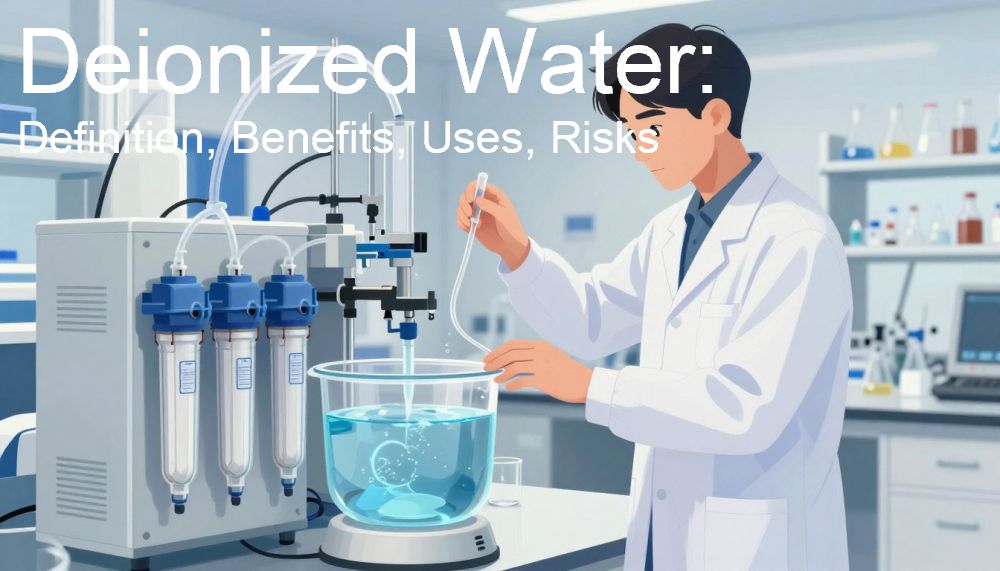
However, it’s essential to understand the potential risks associated with consuming or using deionized water, such as its lack of minerals and potential to leach minerals from the body or equipment.
Key Takeaways
- Deionized water is a type of purified water that has been treated to remove impurities and minerals.
- It has various benefits, including preventing mineral buildup in equipment.
- Deionized water is suitable for use in laboratories and medical facilities.
- There are potential risks associated with consuming or using deionized water.
- Understanding the definition, benefits, uses, and risks is crucial for safe and effective use.
What Is Deionized Water?
Deionized water, often referred to as DI water, is a type of purified water that has been treated to remove its ions. This process results in water that is highly pure and suitable for various applications where mineral-free water is required.
The Science Behind Deionization
Deionization is achieved through ion exchange technology, where resins remove ions from the water, exchanging them for H+ and OH- ions, which then combine to form water. This process effectively removes dissolved solids, resulting in highly purified water.
The ion exchange process involves passing the water through resins that attract and hold ions, thus purifying the water. This method is highly effective for producing water with very low conductivity.
Properties of Ion-Free Water
Ion-free water, or deionized water, has several distinct properties. It has very high resistivity, indicating low conductivity due to the absence of ions. This water is also characterized by its lack of dissolved solids, making it ideal for applications requiring high purity.
The absence of ions in deionized water makes it useful in laboratories, manufacturing, and other industries where mineral-free water is necessary. Its purity is a significant advantage in these contexts.
The Production Process of Deionized Water
Ion exchange technology is at the heart of deionized water production, enabling the removal of charged particles. This process is crucial for producing water that meets the high purity standards required in various industries.
Ion Exchange Technology
Ion exchange technology involves the use of resins that attract and hold ions from the water passing through them. These resins are categorized into two main types: cation exchange resins and anion exchange resins.
Cation and Anion Exchange Resins
Cation exchange resins remove positively charged ions, while anion exchange resins remove negatively charged ions. Together, they work to deionize the water, making it highly pure.
Regeneration Process
The regeneration process involves rejuvenating the ion exchange resins so they can continue to remove ions effectively. This is typically done using chemicals that restore the resins’ ion exchange capacity.
Modern Deionization Systems
Modern deionization systems have evolved to include advanced technologies that enhance efficiency and purity. These systems often combine multiple stages of ion exchange and may include additional purification methods.
| Technology | Description | Benefits |
|---|---|---|
| Ion Exchange | Uses resins to remove ions | High purity water, efficient |
| Regeneration | Rejuvenates resins | Cost-effective, extends resin life |
| Multi-stage Systems | Combines multiple purification methods | Enhanced purity, flexibility |
Deionized Water vs. Other Water Types
When it comes to water quality, deionized water stands out among other types, including purified and demineralized water. The differences between these water types are significant and impact their applications and uses.
Deionized vs. Distilled Water
Deionized and distilled water are both highly purified forms of water, but they are produced through different processes. Distilled water is produced by boiling the water and then condensing the steam, removing many contaminants. Deionized water, on the other hand, is produced through an ion exchange process that removes ions and minerals. While both are pure, deionized water may contain non-ionic contaminants, whereas distilled water can be more prone to contamination during the condensation process.
Deionized vs. Tap Water
Tap water contains various minerals and ions, which can be beneficial for health but may not be suitable for certain applications, such as laboratory testing or industrial processes. Deionized water, lacking these minerals and ions, is ideal for applications where purity is crucial. Tap water’s quality can vary significantly by location, whereas deionized water’s quality is consistent due to its rigorous purification process.
Deionized vs. Purified and Demineralized Water
Purified water is treated to remove contaminants and minerals, similar to deionized water, but the methods can vary. Demineralized water is essentially the same as deionized water, as both have had their mineral ions removed. The terms are often used interchangeably, though demineralized water might be produced through different methods, such as reverse osmosis or electrodialysis.
| Water Type | Production Method | Purity Level |
|---|---|---|
| Deionized Water | Ion Exchange | High |
| Distilled Water | Distillation | High |
| Tap Water | Treatment and Distribution | Varies |
| Purified Water | Varies (e.g., Reverse Osmosis, Distillation) | High |
| Demineralized Water | Varies (e.g., Ion Exchange, Reverse Osmosis) | High |
Key Benefits of Using Deionized Water
Deionized water is highly valued for its purity and versatility in industrial and laboratory settings. Its unique properties make it an ideal choice for various applications where high purity is required.
High Purity Advantages
One of the primary benefits of deionized water is its high purity level. This is achieved through the deionization process, which removes virtually all ions and impurities, resulting in water that is extremely pure. High purity water is essential in applications where even the slightest contamination could affect the outcome or quality of the product.
Absence of Mineral Deposits
Deionized water lacks mineral deposits, which can be a significant advantage in certain applications. The absence of minerals prevents scaling and staining, common issues associated with mineral-rich water. This characteristic makes deionized water particularly useful in industrial processes and cleaning applications.
Enhanced Cleaning Properties
Deionized water’s purity and lack of minerals also contribute to its enhanced cleaning properties. It is effective in cleaning surfaces without leaving residues or causing damage, making it ideal for use in laboratories, manufacturing facilities, and other environments where cleanliness is paramount.
| Benefit | Description | Application |
|---|---|---|
| High Purity | Extremely pure water due to the removal of ions and impurities | Laboratory settings, pharmaceutical manufacturing |
| Absence of Mineral Deposits | Prevents scaling and staining due to lack of minerals | Industrial processes, cleaning applications |
| Enhanced Cleaning Properties | Effective cleaning without residues or damage | Laboratories, manufacturing facilities, electronics cleaning |
Common Uses and Applications of Deionized Water
With its unique properties, deionized water is utilized in diverse fields, including laboratories, manufacturing plants, and medical facilities. Its high purity level makes it an essential component in various applications where mineral-free water is required.
Laboratory and Scientific Applications
In laboratory settings, deionized water is used for experiments and analytical procedures where the presence of ions could interfere with results. It is also used to prepare solutions and as a solvent in various scientific research.
Industrial and Manufacturing Uses
Deionized water is crucial in industrial processes, including cooling systems and manufacturing processes where mineral deposits could cause equipment damage. It is also used in the production of cosmetics, pharmaceuticals, and food products.
Medical and Pharmaceutical Applications
In medical and pharmaceutical settings, deionized water is used for sterilization and cleaning of equipment. It is also used in the preparation of medical solutions and as a component in pharmaceutical products.
Automotive and Electronics Uses
The automotive and electronics industries rely on deionized water for various applications, including car battery maintenance and electronics manufacturing. Its purity ensures that components are free from mineral deposits that could cause damage.
Overall, the applications of deionized water are vast and varied, highlighting its importance in maintaining purity and preventing equipment damage across different industries.
Potential Risks and Limitations
While deionized water offers numerous benefits, its use is not without potential risks and limitations. As we explore the advantages of deionized water, it’s equally important to understand its drawbacks to ensure safe and effective use.
Is Deionized Water Safe to Drink?
Drinking deionized water is a topic of concern due to its lack of minerals and potential health implications. The primary concerns include mineral leaching and taste considerations.
Mineral Leaching Concerns
Deionized water, being highly pure, can leach minerals from the body or materials it comes into contact with. This characteristic raises concerns about its safety for consumption and use in certain applications.
Taste Considerations
The taste of deionized water is often described as flat or neutral due to the absence of minerals. This can be a significant factor for drinking water, where taste is an important consideration.
Material Compatibility Issues
Deionized water can be corrosive to certain materials due to its high purity and lack of ions, which can lead to compatibility issues in industrial and laboratory settings. Material selection is crucial when using deionized water to prevent damage to equipment.
Environmental and Cost Considerations
The production of deionized water requires significant amounts of energy and resources, contributing to environmental concerns. Additionally, the cost of producing deionized water can be high, making it a costly option for many applications.
| Risks/Limitations | Description | Impact |
|---|---|---|
| Mineral Leaching | Deionized water can leach minerals from materials or the human body. | Health and material integrity risks. |
| Taste | Deionized water lacks minerals, resulting in a flat taste. | Affects drinking water acceptability. |
| Material Compatibility | Corrosive nature can damage certain materials. | Equipment damage and maintenance issues. |
| Environmental Impact | High energy and resource requirements for production. | Contributes to environmental footprint. |
| Cost | Production of deionized water is costly. | Increases operational expenses. |
Conclusion
Deionized water, or DI water, has been the focus of this article, exploring its definition, benefits, uses, and potential risks. Through the deionization process, water is purified to a high degree, making it suitable for various applications.
The benefits of deionized water, including its high purity and absence of mineral deposits, make it an essential component in laboratory and scientific applications, industrial manufacturing, medical and pharmaceutical uses, as well as automotive and electronics applications.
While deionized water offers numerous advantages, it’s crucial to acknowledge its potential risks, such as material compatibility issues and environmental considerations. Understanding these aspects is vital to harnessing the benefits of deionized water effectively.
In conclusion, deionized water plays a significant role in various industries, and its unique properties make it an indispensable resource. By recognizing its benefits and risks, individuals and organizations can utilize deionized water efficiently and safely.